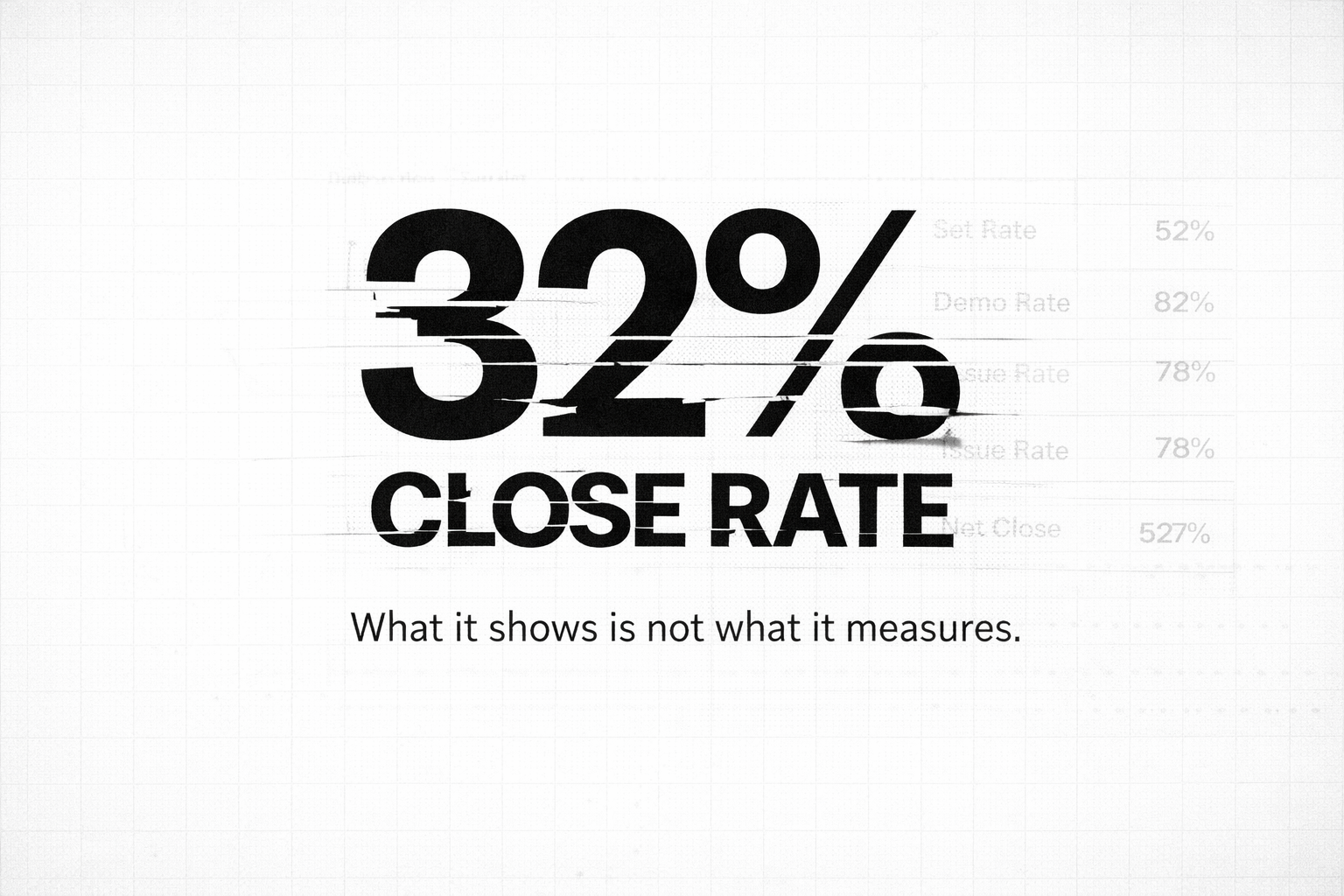
Most companies have a close rate number they trust.
It shows up in meetings.
It gets referenced in conversations.
It becomes the number people point to when they want to explain what's happening.
And on paper, it usually looks fine.
Stable.
Predictable.
Within range.
Which is why nobody questions it.
The number isn't wrong because it's inaccurate.
It's wrong because it answers a different question than the one people think they're asking.
What most companies call “close rate” is a dangerously incomplete number. It is also a blended number.
Leads come in from different sources.
They move through different paths.
They get set, run, cancelled, rescheduled, no-showed.
And somewhere along the way, all of that gets compressed into a single percentage.
One number meant to represent performance.
The problem is that number is carrying too much weight.
It's trying to describe things that don't behave the same way.
A lead that was never contacted.
A lead that set and cancelled.
A lead that sat for two days before follow-up.
A lead that turned into a demo within an hour.
They don't belong in the same conversation.
But they end up in the same number.
And once they do, the number starts to drift away from reality.
Quietly.
You can usually feel it before you can explain it.
The close rate looks fine.
The revenue doesn't.
It shows up in conversations in a specific way.
The number gets defended.
The outcome gets explained away.
Sales says the leads weren't good.
Marketing says the volume is there.
Operations says cancellations are just part of the business.
Everyone has an explanation.
The number stays intact.
That's where the confusion sets in.
Because if the number you're watching says performance is stable, the assumption becomes that the system is working.
So attention shifts elsewhere.
Lead volume.
Marketing spend.
Rep performance.
Anything but the number itself.
But the issue isn't always performance.
Sometimes it's definition.
A blended close rate doesn't tell you how well your team converts opportunities.
It tells you how a mixed set of conditions behaved over a period of time.
Those are not the same thing.
When you separate the stages into what got signed versus what stayed,
lead to set,
set to demo,
demo to close,
the story almost always changes.
Not dramatically.
But enough.
The sources that looked efficient start to move.
The reps that appeared consistent start to separate.
The patterns that were hidden inside the blended number start to show up.
Most companies already have the data to see this.
It's just sitting in places that don't connect cleanly.
So the number stays.
It continues to get reported.
It continues to get trusted.
Not because it's right.
Because it's familiar.
And over time, it becomes one of those numbers that feels important…
without actually explaining what's happening.
The close rate number isn't useless.
It just isn't answering the question you're using it to answer. The stage suppressing every stage after it is upstream.
And most of the decisions being made around it assume that it is.
Most companies already have the data to see this. They just don't have a way to connect it.
Get the next observation when it publishes.