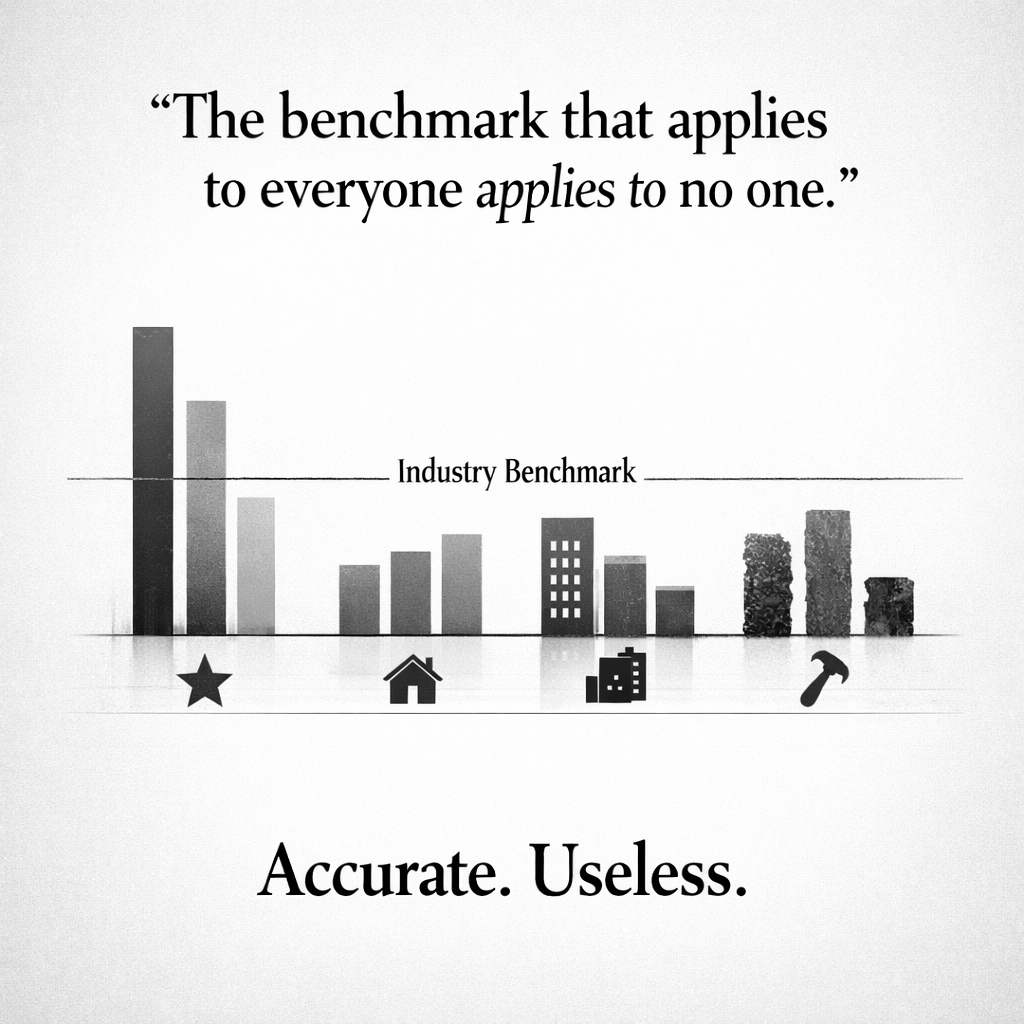
Industry benchmarks for bath remodeling close rate exist in most trade publications, agency reports, and peer group conversations.
A typical number gets quoted somewhere between 30 and 35 percent.
That number is widely shared.
It appears in sales training decks.
It gets used as a goal.
It gets used as a diagnosis when performance falls short.
The problem is that the number describes four structurally different operator models at once.
That blend tells both operators nothing useful about their own performance, and gives the independent operator a benchmark they can never reach.
Because the close rate each of those models produces is shaped more by their structural position than by their sales execution.
And once you separate them, the benchmark stops making sense.
Tier 1: National corporate brands.
These are the manufacturer-owned or corporate-operated operations running under a national name.
They arrive at the demo with brand recognition already doing the work.
The prospect has seen the commercials, received the mail pieces, and heard the name in their neighborhood.
Close rate for this tier tends to run highest in the industry because a meaningful share of the selling work happens before the rep arrives.
Tier 2: Independent product dealers.
These are independent operators who sell a recognized manufacturer's product under licensing or dealer agreements.
The product carries some recognition.
The operator brand generally does not.
Close rate for this tier sits below Tier 1 but above Tier 4, because the product name carries partial credibility the rep would otherwise have to earn from scratch. In the room, in real time, on the strength of the rep and the presentation alone.
Tier 3: Corporate-owned locations of national franchise brands.
These are the corporate-run flagship operations, usually in major metros.
They sit above the franchise average because they have first access to leads, proprietary training, and the strongest reps in the system.
Their close rate is internally comparable in a way no franchise network or independent operator can match. Because the variables are actually controlled.
Tier 4: Independent operators with no national brand.
These are the businesses with a local reputation, a local crew, and a local name.
They arrive at the demo with the prospect having done their own research and made a short list that probably includes a national brand and a product dealer alongside them.
Their close rate reflects everything they are doing right, and is still being compared to operators who had a head start.
So when a benchmark averages these four tiers, the result is a number that describes none of them.
It understates Tier 1.
It overstates Tier 4.
And the larger operators in the sample distort the average upward because their demo volume carries disproportionate weight.
A national brand running 400 demos a month carries more statistical weight than the independent operator running 40, and the resulting average drifts toward the operator with institutional advantages.
This has consequences.
The independent operator sees the benchmark, compares themselves to it, and concludes their sales team is underperforming.
They hire a consultant.
They retrain the team.
They adjust the presentation.
None of which will close the structural gap that exists between their tier and the blended average.
The issue is not that they are behind on sales skills.
The issue is that they are being measured against operators with manufacturer support, centralized training, brand recognition, and corporate marketing budgets, and interpreting the gap as a sales problem.
A Tier 4 operator closing 22 percent of their demos may be running a high-performance sales organization.
A Tier 1 operator closing 35 percent may be structurally underperforming what their position should produce.
Both look wrong against the benchmark.
Both can be misread as problems they are not.
Useful benchmarks require tier-matched comparisons.
A Tier 4 operator comparing themselves to other Tier 4 operators learns something actionable about their own performance.
A Tier 4 operator comparing themselves to a blended average learns something misleading.
Most industry benchmarks are blended.
Very few are tier-matched.
Which means the number that shows up most often is the number least likely to be useful for the operator using it.
The practical implication is that close rate, on its own, against an industry benchmark, is rarely a diagnostic tool.
It is a comparison tool that only works when the comparison is structurally valid.
Without tier separation, it isn't.
Everything else is noise dressed up as data. Acting on it produces decisions that make sense on paper and degrade performance in practice.
The benchmark that applies to everyone applies to no one.
The data is already there. The visibility isn't. So the decisions stay wrong.