Every sales team reports close rate.
It shows up in weekly reviews.
It gets tracked by rep.
It gets used to evaluate sources, training, and performance.
It is also, almost always, incomplete.
Not because the math is wrong.
Because it stops too early.
Close rate measures the moment a contract gets signed.
It does not measure whether that contract stayed.
And in home improvement, those are two very different events.
A contract that cancels within 72 hours cost you everything a retained job cost you.
The lead.
The call.
The appointment.
The demonstration.
The close.
None of it comes back.
But in most reporting, a cancellation is just a cancellation.
It gets noted.
It gets counted.
It reduces the revenue number.
What it doesn't do is change the close rate.
Because close rate is calculated at the point of signing.
Not at the point of retention.
Which means your top-line performance number is measuring something that hasn't finished happening yet.
The contract was signed.
But the job hasn't run.
The revenue hasn't cleared.
The cancellation window hasn't closed.
And yet the close rate gets reported.
As if the outcome is already known.
There is a more complete number.
It takes the close rate and adjusts it for what actually stayed.
Retention-adjusted close rate.
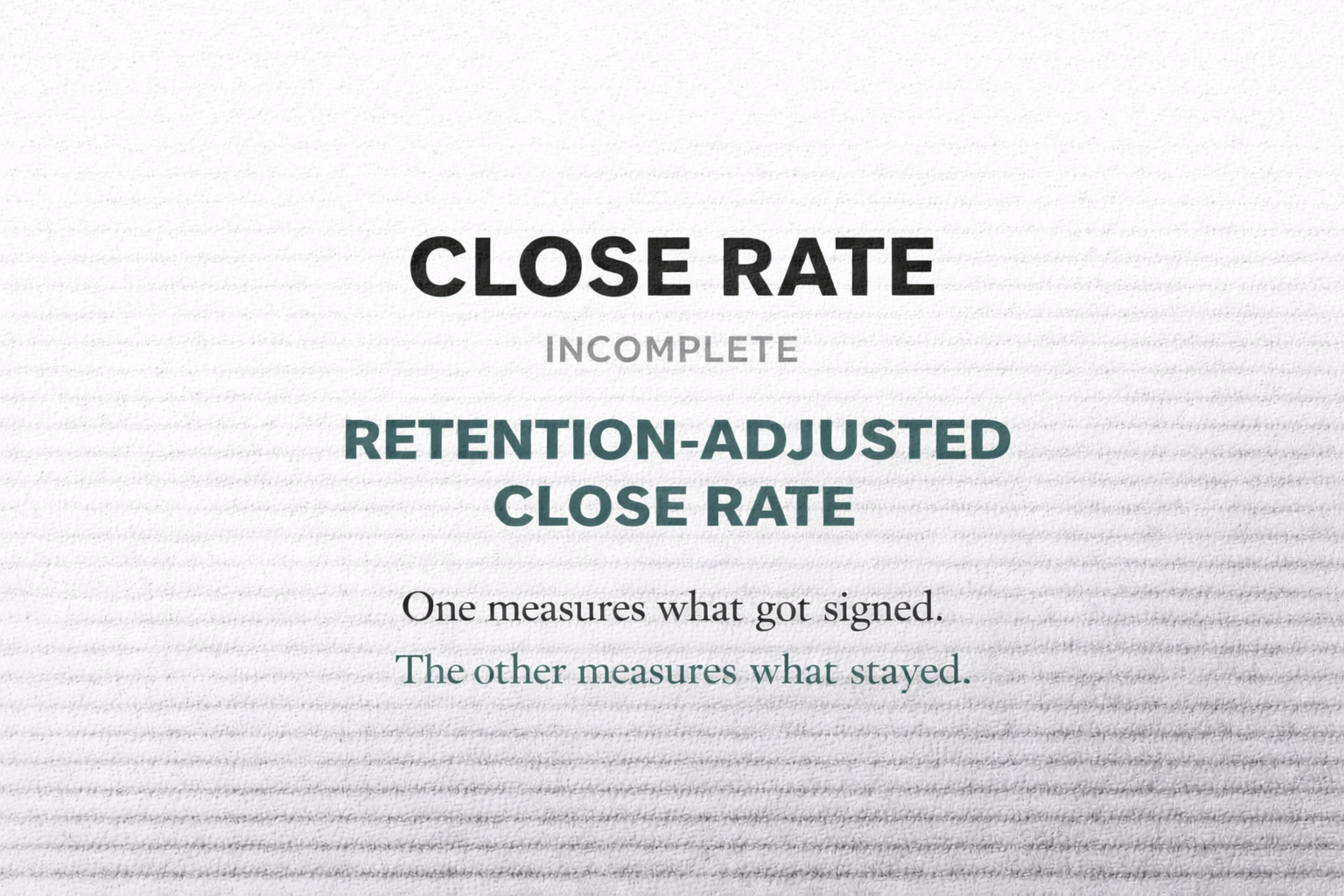
Close rate measures what got signed.
Retention-adjusted close rate measures what stayed.
The calculation is straightforward.
Jobs retained divided by demonstrations run.
Not jobs signed.
Jobs retained.
When you run both numbers side by side, something shifts.
The rep who looked like your strongest closer may not be your most valuable one.
The source that looked efficient may not be producing revenue that stays.
The month that looked strong may have been built on contracts that were already leaving.
None of that exists in a standard close rate.
All of it is visible in a retention-adjusted one.
The difference between the two numbers is not a rounding error.
In most home improvement operations, it's significant.
Close rate tells you what got signed.
Retention-adjusted close rate tells you what the business actually kept.
Most companies are running their sales operation on the first number.
The second one is the one that tells the truth.
The data is already there. The visibility isn't. So the decisions stay wrong.