Most companies evaluate lead sources the same way.
They look at what the lead costs.
And they make decisions from there.
It's a reasonable place to start.
It's just not where the answer lives.
The number that shows up on the invoice is not the cost of the lead.
It's the price of receiving it.
Those are different things.
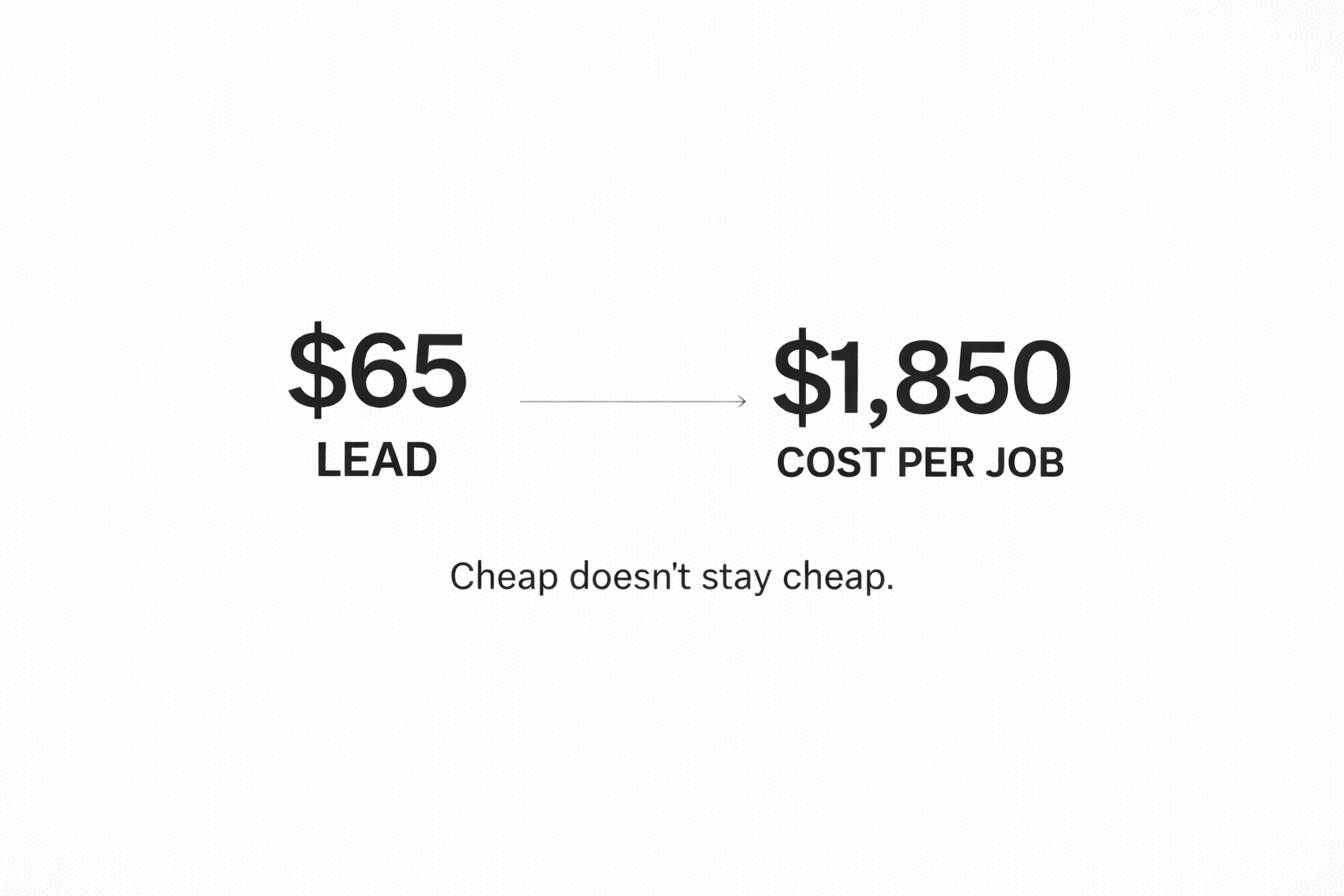
A lead at $65 looks efficient.
A lead at $220 looks expensive.
On paper, the math seems obvious.
So the budget stays heavy toward the cheaper source.
But here's what the invoice doesn't show.
What happened after the lead arrived.
Whether it picked up the phone.
Whether it set an appointment.
Whether the appointment ran.
Whether the job closed.
Whether the job stayed closed.
The $65 lead and the $220 lead don't behave the same way through that sequence.
They almost never do.
The cheaper lead often arrived with less intent. It was probably sold to several contractors simultaneously.
It submitted a form somewhere.
It got distributed to several contractors simultaneously.
By the time your team called, it had already heard from two others.
The more expensive lead often arrived differently.
More friction in the intake.
More specificity in the request.
More readiness to have the conversation.
You can usually see this in the numbers.
Set rate.
Demo rate.
Close rate.
Cancel rate.
The sources at the bottom of those rankings are rarely the most expensive ones per lead.
They're usually the cheapest.
Most companies already sense this.
The cheap source feels harder to work.
The team knows it.
Operations knows it.
But the invoice still says $65.
And $65 still wins the budget conversation.
Because the number that drives the decision is the one that's easiest to see.
Not the one that's most accurate.
The actual cost of a lead isn't what you paid to receive it.
It's what you paid to turn it into revenue.
And most companies have never calculated that number.
Most companies already have the data to see this. They just don't have a way to connect it.