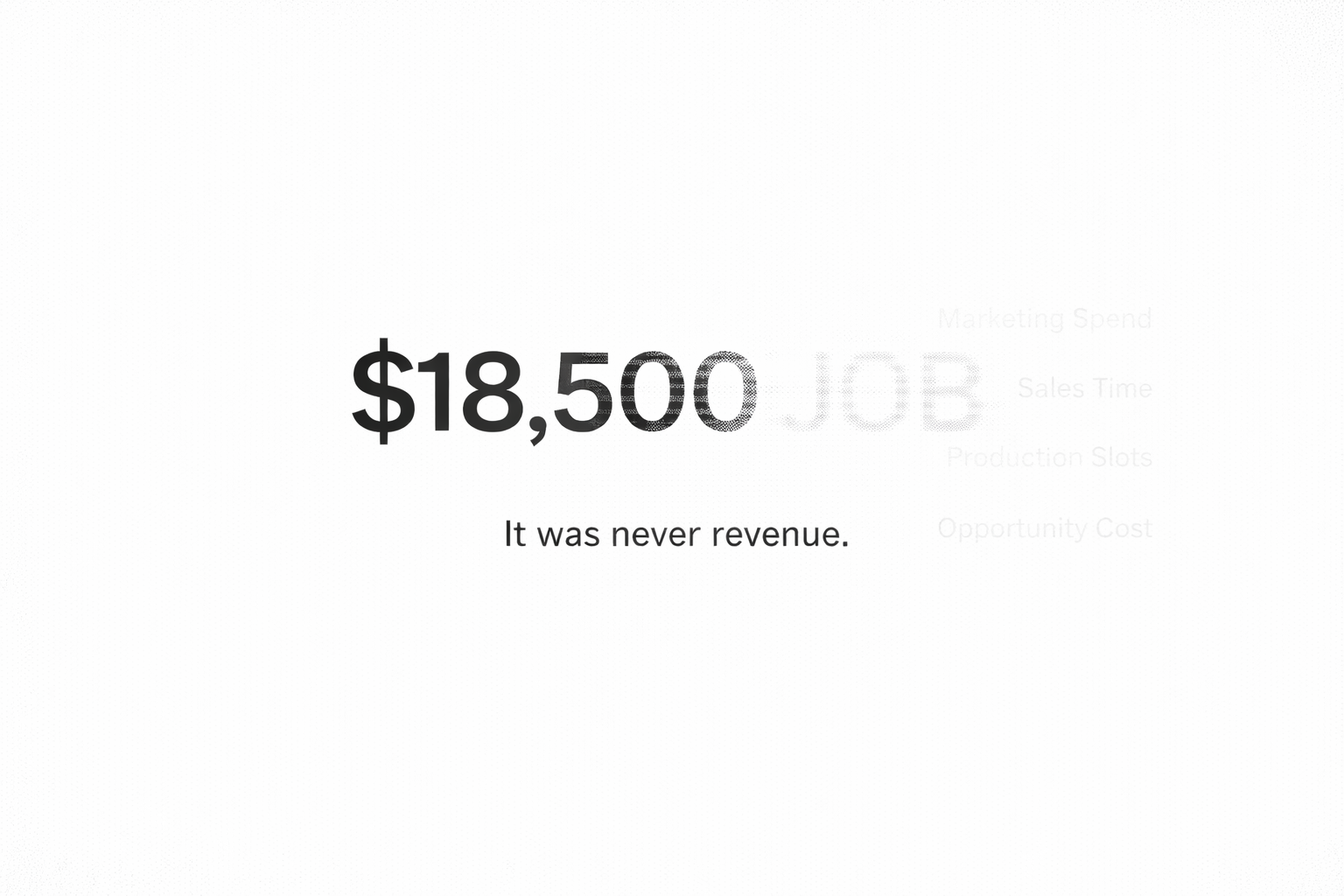
When a job cancels, there's a number that gets noted.
The contract value.
That's what shows up in the report.
That's what gets discussed.
But that number is missing something.
By the time a job cancels, the business has already spent money to produce it.
Money that doesn't come back when the contract does.
The lead was paid for.
The call was made.
The appointment was set, confirmed, and held.
A salesperson drove to the home and ran a two-hour demonstration.
The contract was signed.
And then it cancelled.
None of those costs reversed.
They were already spent.
So when people say a job cancelled and they lost the revenue.
They're right.
But they're only telling part of the story.
The other part is what it cost to produce that revenue in the first place.
In home improvement, that number is significant.
Marketing cost.
Sales cost.
Administrative cost.
Scheduling and logistics, especially if the cancellation came late.
Add it up and the true cost of a cancelled job is almost always higher than the contract value suggests.
Not slightly higher.
Meaningfully higher.
Which changes how seriously cancellation rate deserves to be taken.
Most companies treat it like a margin issue.
Something to manage.
Something to keep within a range.
But it isn't just a margin issue.
It's a revenue problem that's already been paid for.
Once to produce it.
And again when it disappeared.
The part that makes this worth looking at.
They cluster.
By source.
By salesperson.
By timing.
Each pattern points somewhere.
To something specific.
Most companies don't look that closely.
They see the blended number.
They note it.
They move on.
The revenue from those jobs was already sold.
The question is whether anyone is looking closely enough to understand why it didn't stay that way.
Most aren't.
Most companies already have the data to see this. They just don't have a way to connect it.