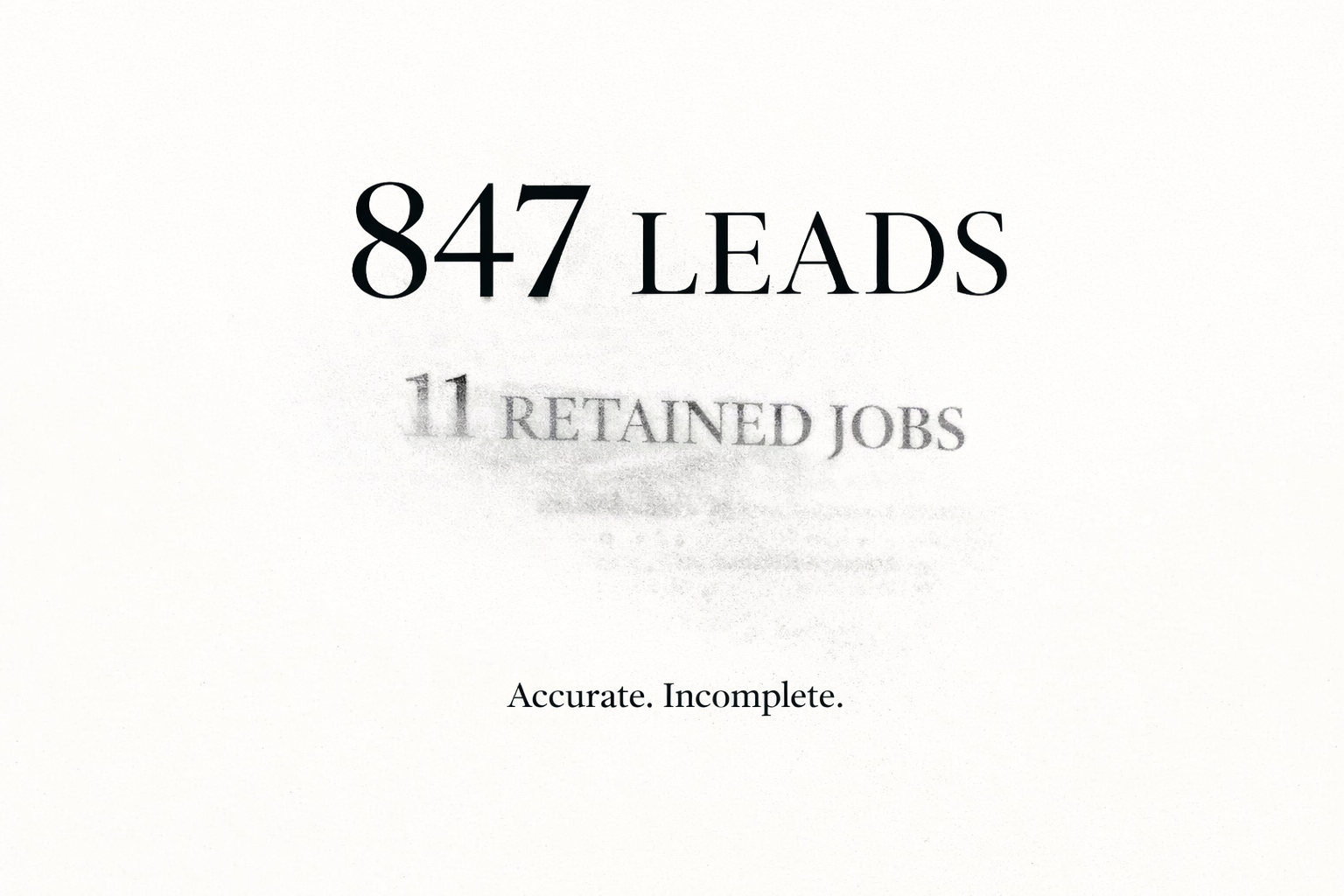
Every month, a report arrives.
Sometimes it's a PDF.
Sometimes it's a dashboard link.
Sometimes it's a slide deck with a cover page.
The format changes.
The metrics don't.
Impressions.
Clicks.
Leads generated.
Cost per lead.
All of it trending in the right direction.
All of it selected carefully.
The report isn't wrong.
The numbers are accurate.
The problem is what they're measuring.
Every metric in a standard agency report has something in common.
It measures what the agency did.
Not what happened after.
Leads generated is a delivery metric.
It tells you how many contacts arrived.
It says nothing about whether those contacts turned into appointments.
Or whether the appointments ran.
Or whether the jobs closed.
Or whether the jobs stayed closed.
Cost per lead is a price metric.
It tells you what you paid to receive a contact.
It says nothing about what it cost to turn that contact into revenue.
Cost per acquired revenue is a truth metric.
Those are different numbers.
They almost never match.
The agency knows this.
It isn't a secret.
The report just isn't built around the number that would tell the full story.
Because that number, cost per acquired revenue by source, requires data the agency doesn't have.
Your CRM.
Your close rates.
Your cancellations.
Your actual job revenue.
The agency has the top of the funnel.
You have the rest.
And nobody is connecting them.
So the report keeps arriving.
The metrics keep looking reasonable.
And decisions keep getting made against a picture that's missing most of what matters.
The leads looked fine.
The revenue told a different story.
Most companies sense this gap exists.
They just don't have a clear way to see it.
So the report stays the report.
And the decision keeps following it.
The data is already there. The visibility isn't. So the decisions stay wrong.