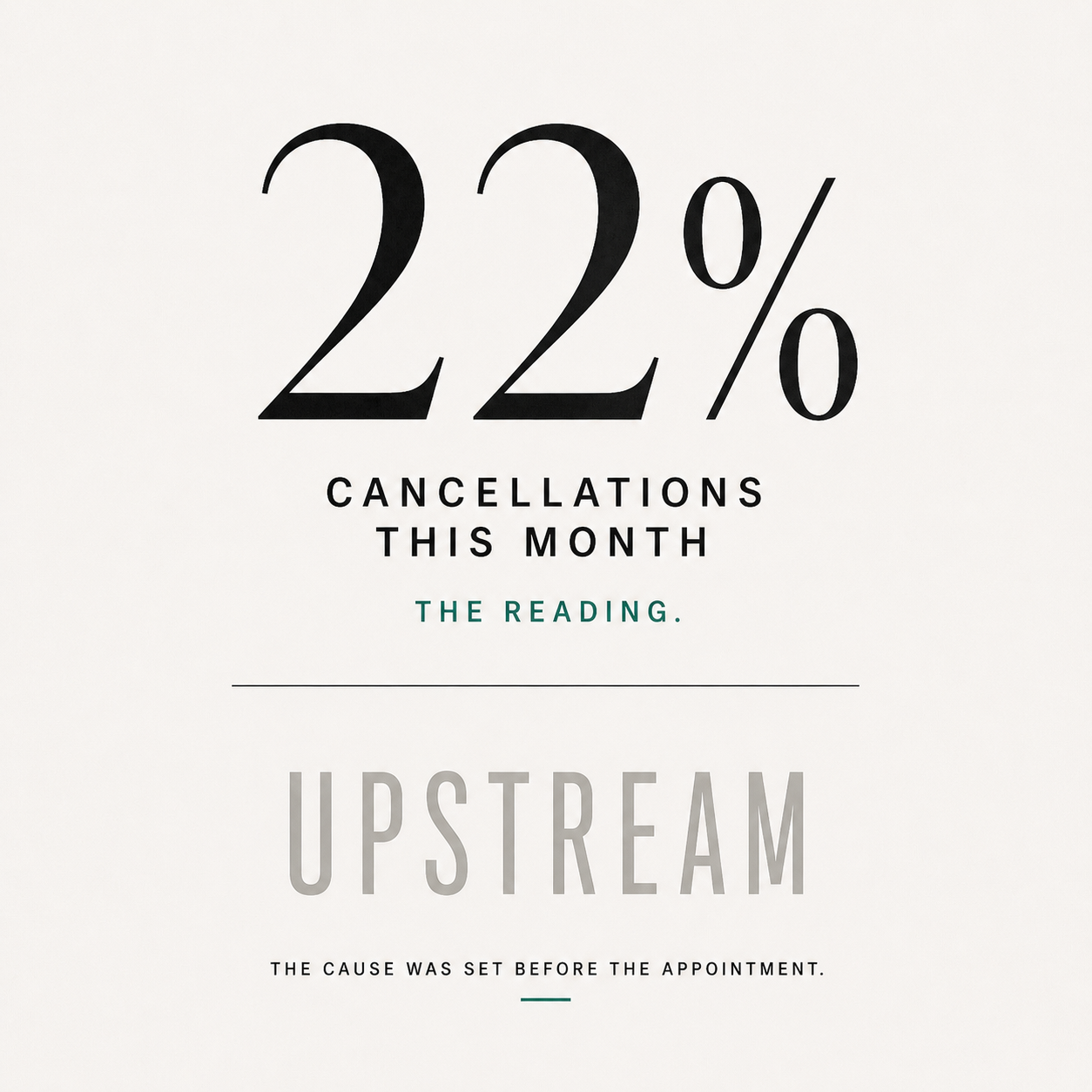
Monday morning.
The setter calls Saturday's appointment to confirm.
The customer answers.
Something came up.
Maybe next week. Maybe never.
The call lasts forty seconds.
Forty seconds to lose what the marketing budget already paid for.
At the end of the month, the owner sees it.
Twenty-two percent.
Higher than last quarter.
The first reading is always the same.
The customer changed their mind.
The economy. The weather.
The setter wasn't firm enough.
The rep didn't close hard enough on the front end.
The reading is wrong.
A cancellation is not customer behavior.
It is a signal.
From earlier. From the source.
The same source produces the same cancel rate.
Month after month. Quarter after quarter.
Different customers. Same number.
Aged data carries its own cancel rate.
Shared platforms carry another.
High-funnel form fills behave differently than intent-stage demand.
Referrals almost don't cancel.
The pattern was set before the appointment was booked.
Before the setter dialed.
Before the customer ever picked up.
The cancellation was upstream.
The Monday morning call is just where it surfaced.
What the cancellation cost is not the appointment.
The lead was already paid for.
The setter hour was already paid for.
The rep slot was already reserved.
The drive time was already scheduled.
The follow-up had already started.
By the time the customer cancelled, the cost was already committed.
The cancel rate disguises itself as a customer problem.
It reads like a sales problem.
It is neither.
It is a portfolio problem. The mix of sources determines the floor.
When the floor moves, the cause is rarely closer to the call.
It was already decided before the call ever happened.
The cancel rate as a sourcing signal, broken down by channel and economics, lives at Verisyn HQ.