The decision feels like growth.
Revenue needs to move.
The lever everyone reaches for is the same one.
More leads.
The plan reads cleanly on paper.
Lead spend up twenty-two percent.
The board agrees.
The marketing director rebalances.
The campaigns expand.
Then the numbers come in.
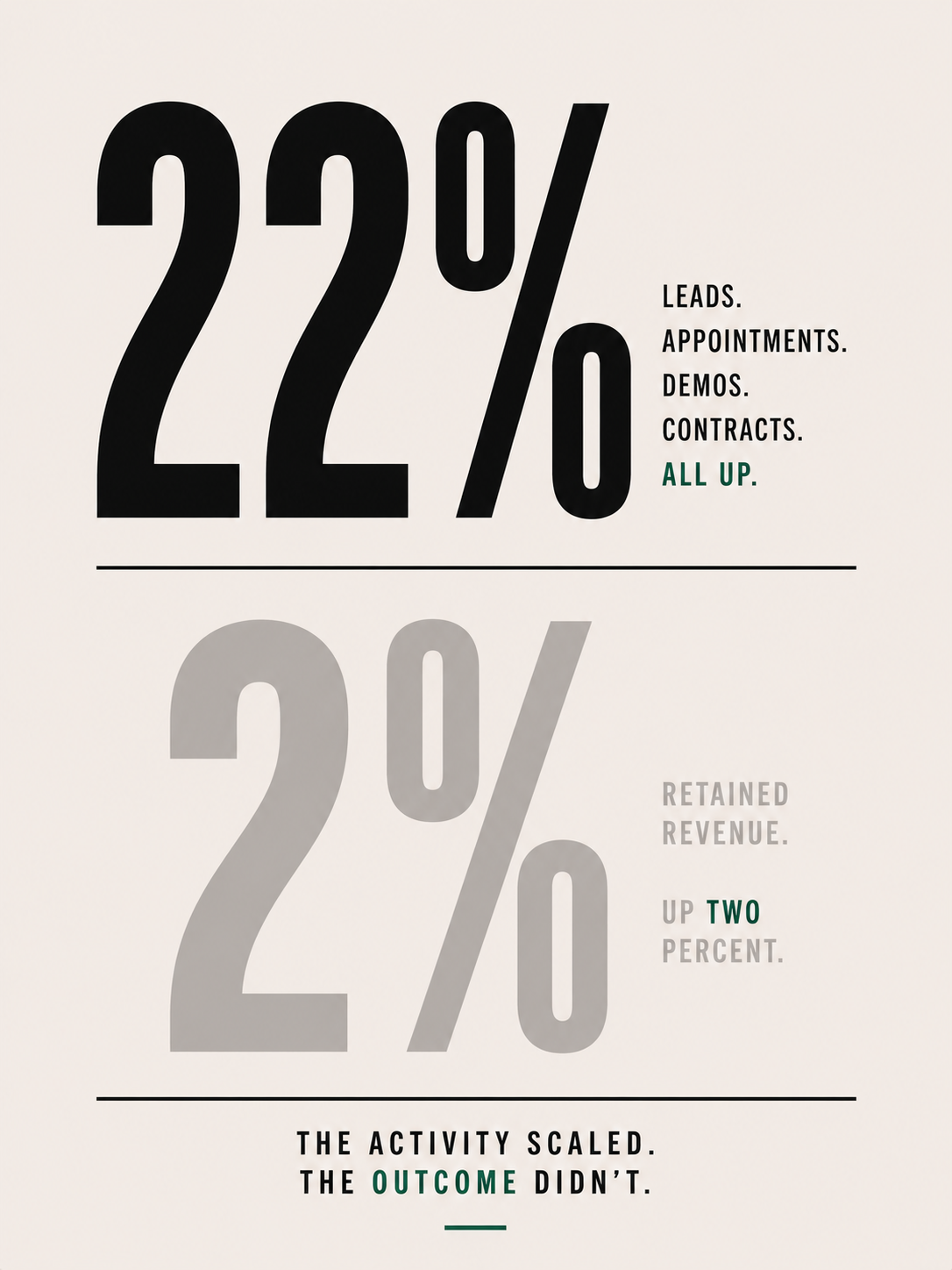
Leads up twenty-two percent.
Appointments up fourteen.
Demos up eleven.
Contracts up nine.
The story holds together as long as you stop reading there.
Most operators stop reading there.
The number that finishes the story arrives ninety days later.
Up two percent.
Cost per retained job up nineteen.
The activity climbed. The outcome did not.
The funnel did not break under volume.
It was already broken before the volume arrived.
The scale just made the break visible in the math.
A healthy funnel converts lead spend into retained revenue at a predictable rate.
Every dollar in produces a known dollar out, adjusted for conversion at each stage.
Scale that funnel and the retained revenue scales with it.
A weak funnel does not behave that way.
The leaks at each stage do not stay constant as volume increases.
They compound.
Contact rate slips. The call center sized for two hundred leads a week does not perform at two-fifty.
Confirmation fallout rises. More appointments competing for the same confirmation hours.
The lead source mix widens to hit the volume target. Shared platforms get added. Cancel rate climbs with them.
Cancellations from the volume push arrive thirty, sixty, ninety days later. The dashboard already showed growth. The P&L shows the outcome.
The dashboard and the P&L are not measuring the same thing.
The dashboard measures activity.
The P&L measures retained revenue.
Activity scaled.
Retained revenue did not.
Three months in, the cancel rate from the volume push starts surfacing.
The board is told the quarter is softer than expected.
The decline is attributed to the market.
To execution.
To timing.
The reading lands on everything except the lever that was pulled.
The decision to scale was not wrong.
The timing of it was.
A weak funnel under spend pressure becomes an expensive funnel.
A healthy funnel under spend pressure becomes a bigger business.
The difference between them is whether the leaks were fixed first.
Most operators do not run the retained revenue math before scaling.
They run it after.
By then, three quarters of decisions have already been made on the wrong picture.
The leak does not scale away. It scales with you.
The data is already there. The visibility isn't. So the decisions stay wrong.