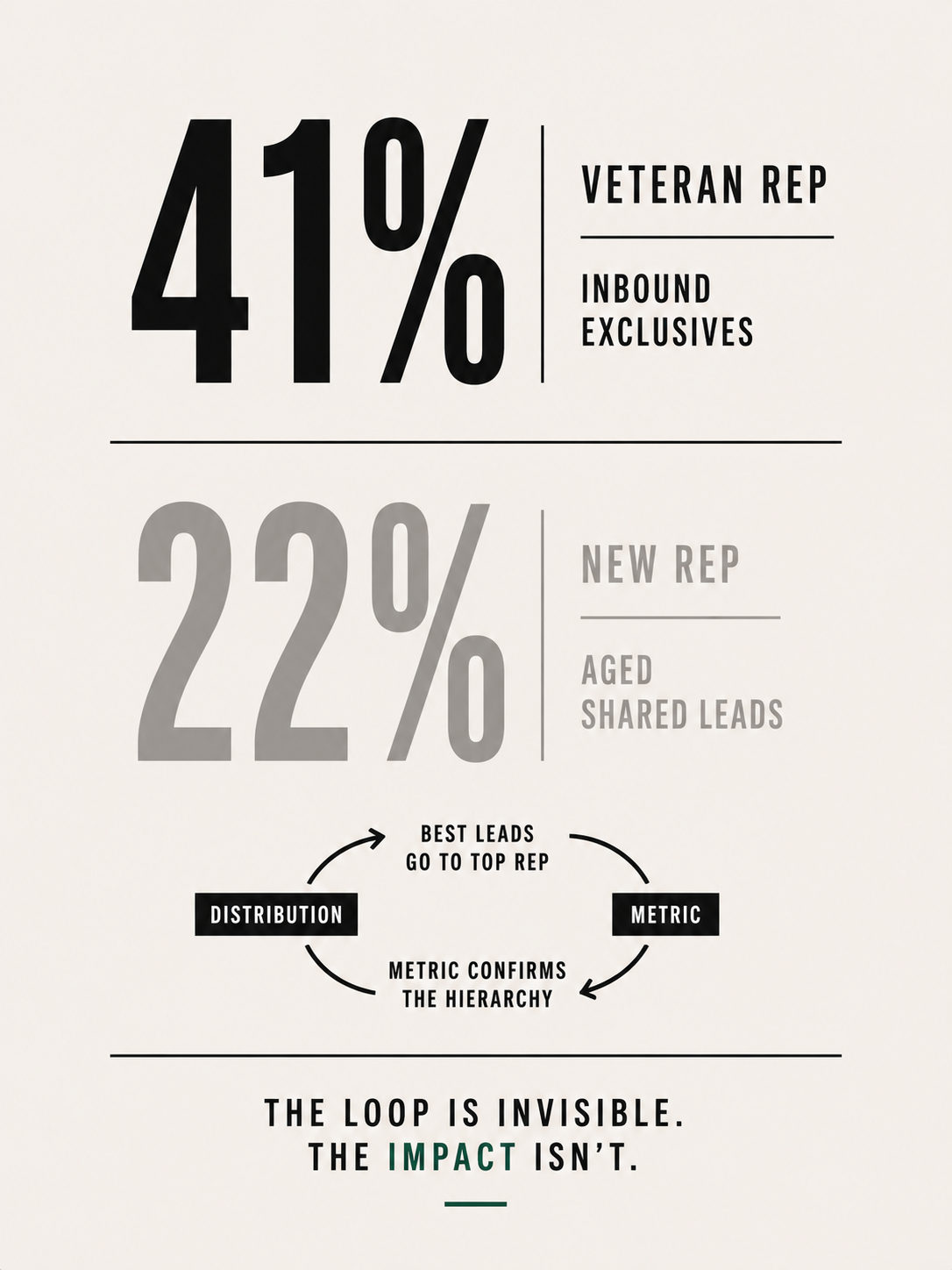
The new rep closes at 22 percent.
The veteran closes at 41.
The manager reads this as a skill gap.
It may be.
It may also be a distribution pattern that has been compounding for two quarters.
The veteran got the inbound exclusives.
The homeowner who requested the consultation directly. The callback lead who has been thinking about the project for six months. The customer who already knows the product line and asked for the appointment by name.
The new rep got the aged shared leads.
The homeowner who filled out the form three weeks ago. The lead who has already spoken to two competitors. The customer who barely remembers submitting the request.
Same close-rate metric.
Different raw material.
Lead distribution in home improvement follows a logic that feels responsible.
The strongest opportunities go to the reps most likely to convert them.
You protect the marketing spend.
You maximize the expensive appointments.
This is not bad management.
This is how every sales floor under pressure naturally operates.
The problem is that close rate by rep does not isolate rep skill from lead quality.
The metric being used to justify giving the veteran the strongest opportunities is the same metric being inflated by that decision.
The loop becomes self-confirming.
The veteran closes the strongest leads at the highest rate.
The new rep closes the hardest leads at the lowest.
The board looks objective.
The distribution already shaped the outcome before the week started.
The hierarchy starts to look permanent.
The veteran stays at the top.
The new rep stays at the bottom.
The manager keeps distributing leads accordingly because the numbers appear to validate the structure.
The metric did not create the hierarchy.
It made the hierarchy difficult to see.
Some new reps push through it.
They learn to close harder material. They improve against weaker inputs. Eventually they earn access to stronger appointments.
That climb is real.
What it does not reveal is whether the veteran at the top of the board would still be there if the assignments had ever been reversed.
That question has no comfortable answer for most operators.
Because the honest version of it is this:
The hierarchy that looks like performance may partly be a record of who got trusted first.
Close rate without source-level context does not measure rep performance alone.
It measures rep performance, lead quality, assignment history, and distribution policy compressed into a single number.
The board calls it ranking.
The operation is often reading allocation history instead.