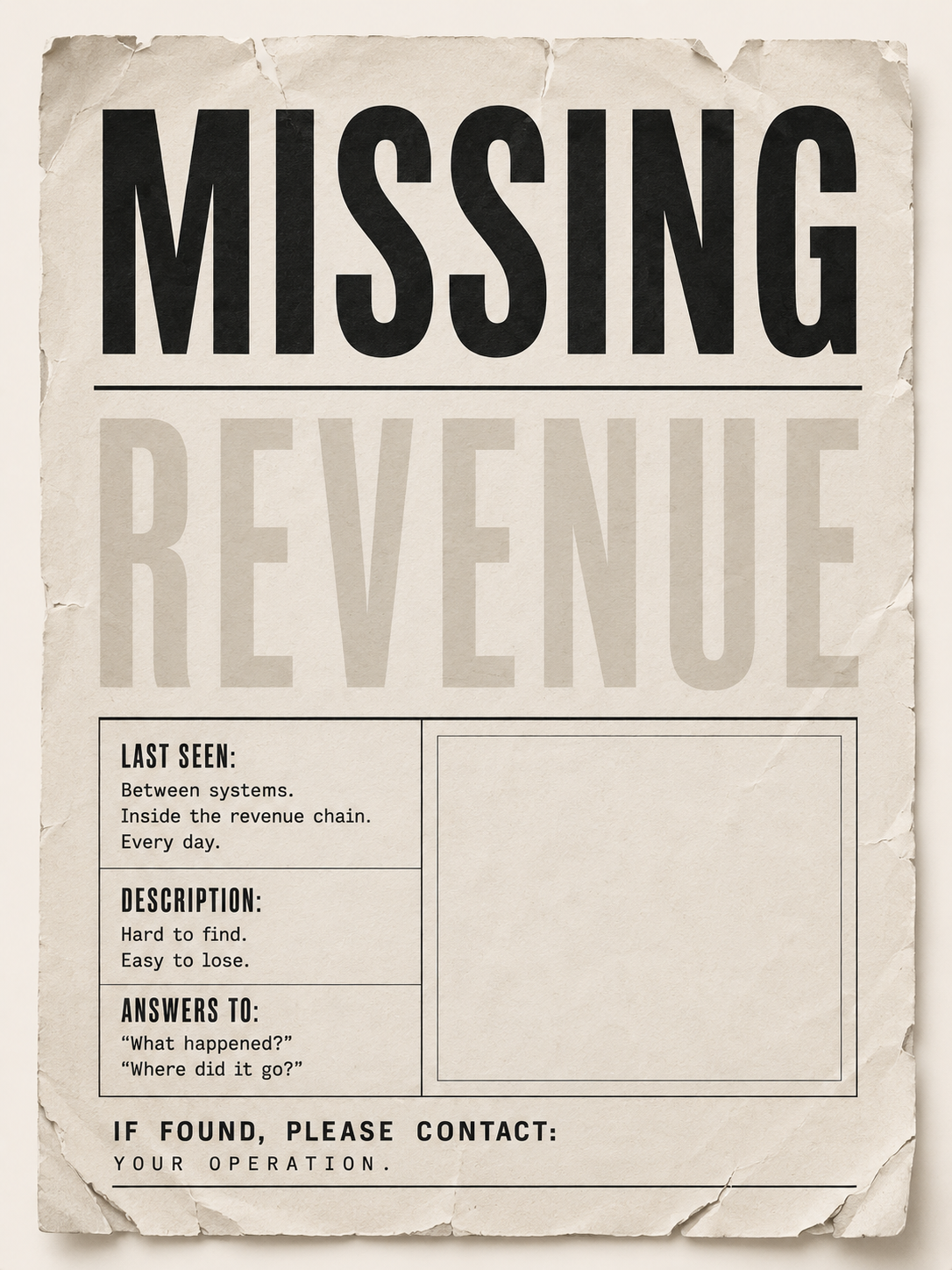
The CRM is active. The pipeline report runs on schedule. The dashboard refreshes every morning. The operation still cannot see where revenue leaves.
Most home improvement companies at the $20M threshold and above have invested in systems. A CRM for leads. A platform for scheduling. Software for production. An accounting tool for the back office. Sometimes all four from different vendors. Sometimes consolidated into one enterprise package that promised to unify them.
The systems fill with data. That part works.
What the systems do not do is speak to each other at the level that matters.
Marketing sees lead volume. Sales sees pipeline. Operations sees job count. Accounting sees invoices. Each department runs a clean report inside its own boundary. The boundaries are where the revenue disappears.
A lead that converts to an appointment does not automatically carry its cost into the close rate calculation. A closed job does not automatically surface its cancellation risk in the pipeline view. A production delay does not automatically appear as a revenue timing gap in the accounting summary.
The data exists. The connection between data points does not.
The enterprise purchase was supposed to solve this.
For companies that moved to unified platforms, the consolidation reduced the number of systems. It did not eliminate the interpretation layer. Someone still pulls the reports. Someone still builds the dashboard. Someone still decides which metrics surface to which level of management and in what format.
That person is not the system. That person is staff. Staff with their own understanding of what the numbers mean, their own judgment about what to surface, and their own bandwidth limits on how deep to look.
The dashboard becomes a translation of the data, not the data itself. And the translation reflects the translator's frame, not the operation's revenue chain.
The cost of all of this sits in the admin line.
Software subscriptions. Implementation fees. The staff hours spent managing inputs, reconciling outputs, building reports, and presenting summaries. It is categorized as an operating expense. It is evaluated as overhead. It is not evaluated against the revenue it was purchased to protect.
No one asks what the CRM cost per retained revenue dollar. No one tracks what the enterprise platform identified in time to act on. The system is assessed on whether it runs, not on whether it surfaces what the operation needs to see.
The gap that costs the most is the one no dashboard was built to show.
Not missing data. Missing connection. The space between what marketing reported, what sales executed, what operations delivered, and what accounting recorded. Each system accurate within its own walls. The revenue leak living in the space between them.
The dashboards were full. The question the operation needed answered was not on any of them.
The structural reasons this gap persists across operations at every scale, and what different visibility looks like when the revenue chain is measured end to end, are examined at Verisyn HQ.